The Baskerville Experiment
experiment designer and data analyst, with Errol Morris and David Dunning, 2011–2015
A quiz on nytimes.com secretly tested whether a sentence's typeface affects its believability across New York Times readers, with Baskerville emerging as the most trusted. The findings were later published as Pentagram Paper 44.
Covered in Design Observer Fast Company kottke.org The Week Fast Company AIGA Eye on Design The Architect's Newspaper Fonts In Use The New York Times Pentagram
In July 2012 the New York Times published a typography experiment formatted as a quiz about the end of the world. Readers were given a passage by the physicist David Deutsch arguing that humanity would survive an asteroid impact, and asked whether they agreed with him. The typeface the passage was set in varied between readers, who were not told this.
David Dunning, the Cornell psychologist who studied how people misjudge their own certainty, and Errol Morris worked on expanding the analysis.
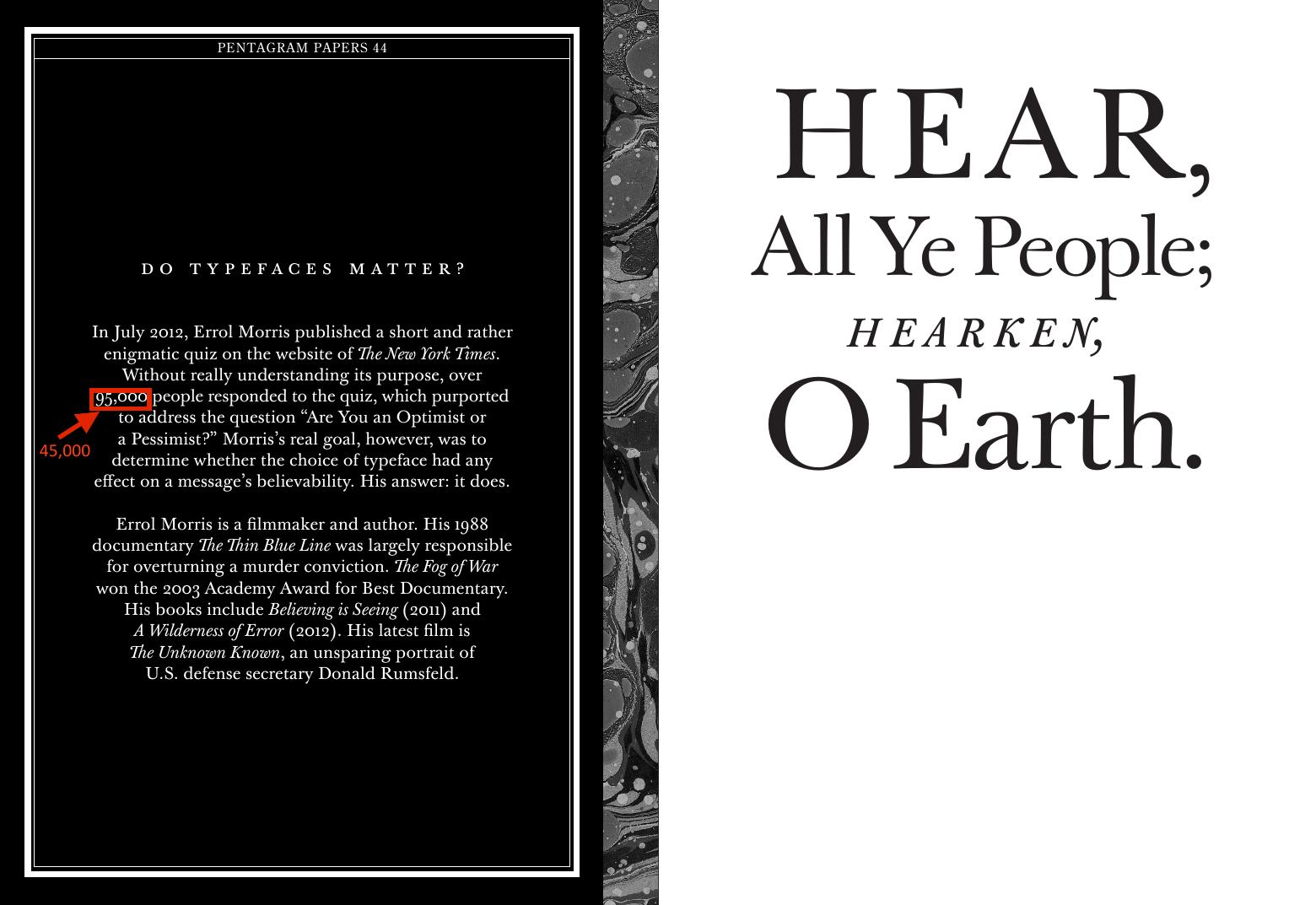
The study ran as Hear, All Ye People; Hearken, O Earth. Pentagram reissued it in 2014 as Paper 44, designed by Michael Bierut and set in Baskerville.